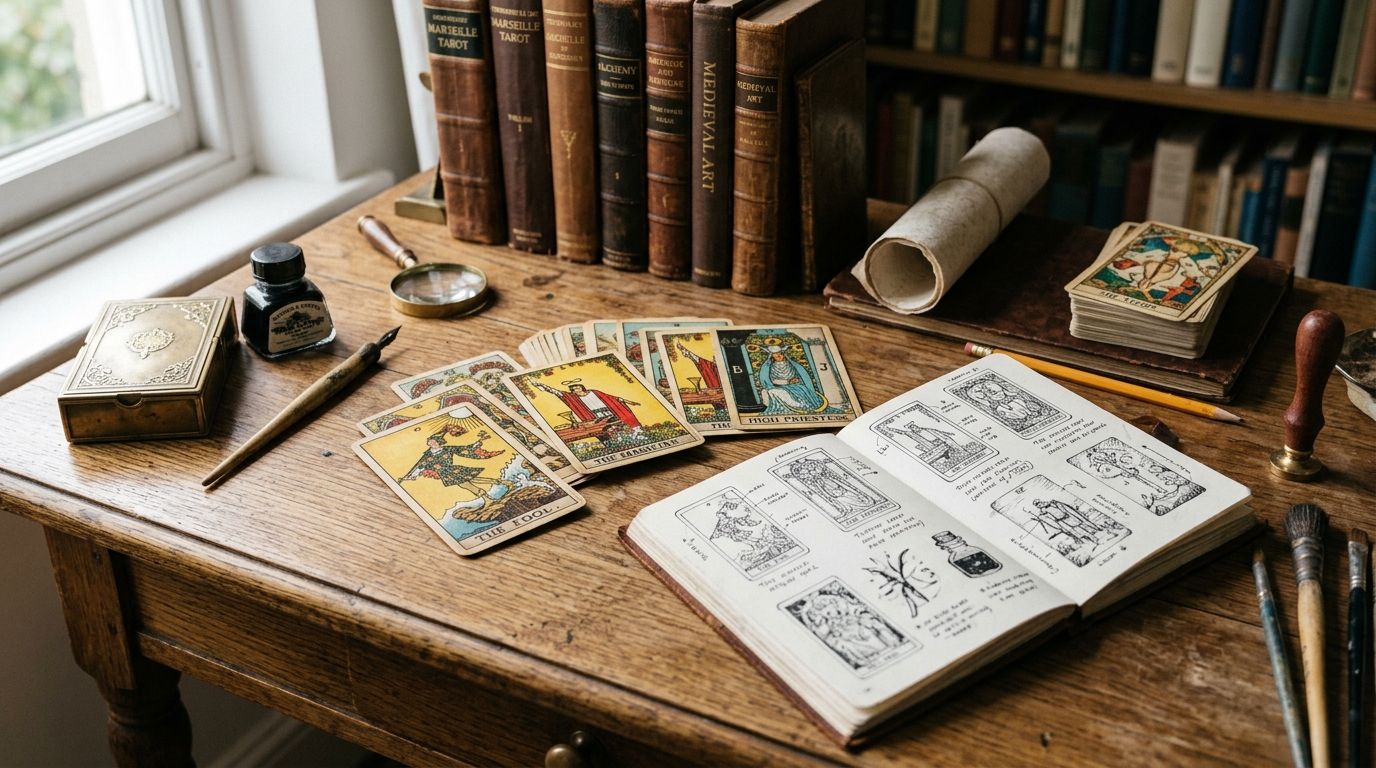
Tarot deck designers need vintage illustrations that read as authentic 19th-century plates, not stock clip art, because tarot buyers in 2026 can spot a Canva template from across a market table. The right archive gives you botanical, anatomical, and ornamental source art that already carries the aging, linework, and printing artifacts a hand-drawn deck needs — without you scanning library microfiche for six weekends straight.
- Century Library's hand-restored plates give tarot deck designers period-accurate botanical, anatomical, and ornamental art without AI generation.
- Vintage illustrations for tarot deck design need consistent aging, era-correct typography, and cleared commercial licensing before any print-on-demand run.
- Public domain archives work for a one-off deck; a subscription library saves time matching restoration quality across all 78 cards.
- Victorian ornamental frames and botanical plates cover suit symbolism faster than commissioning original art card by card.
Why vintage illustrations matter for tarot deck design
Tarot has a visual language built over 500 years — the Rider-Waite-Smith deck (1909) and the older Sola Busca deck set expectations readers still recognize today. A modern deck built from flat vector icons or AI-generated art skips that visual inheritance entirely, and tarot buyers notice.
Designers working in Century Library's catalogue skip the scanning-and-cleanup phase because the plates are already hand-restored to print resolution. That matters more for tarot than most projects: a standard tarot card prints at roughly 2.75 x 4.75 inches, small enough that soft, low-resolution scans go visibly mushy the moment you add a border and typography on top.
The other constraint unique to this segment: you're not designing one image, you're designing a coherent set of 78, each one needing the same era, the same linework weight, and the same aging treatment. That consistency problem is the whole game.
Audit your arcana list before you source anything
Start with a spreadsheet, not a mood board. List all 22 Major Arcana and all 56 Minor Arcana (four suits x 14 cards) and note what imagery each card traditionally needs — figures, tools, animals, celestial bodies, plants.
- Group cards by recurring visual motif (swords = weapons and birds, pentacles = coins and botanicals, cups = vessels and water, wands = fire and staffs)
- Flag cards that need a human figure versus cards that can work as still-life or symbolic composition
- Note which cards repeat a motif (four Kings, four Queens) so you can reuse one illustration family instead of sourcing four separate ones
- Decide your card size and bleed now — it changes what resolution you actually need from source art
Pull botanical and anatomical plates for suit symbolism
Pentacles and Cups lean hard on natural-world imagery — flowers, fruit, vines, shells. Anatomical plates (hands, hearts, skeletal figures) cover Death, the Hanged Man, and other body-centric Major Arcana cards without redrawing anatomy from scratch.
- Search botanical plates by plant symbolism first, not just aesthetics — roses for Cups, wheat or coin-shaped seed pods for Pentacles
- Pull anatomical engravings for cards with body focus (Death, Temperance, the Hanged Man) rather than illustrating figures freehand
- Keep a folder per suit so restoration style stays visually matched across all 14 cards in that suit
- Century Library's vintage botanical illustrations for brand identity collection is built for exactly this kind of symbol-matching work, and the license covers commercial print runs
Source ornamental frames and borders for card backs and edges
Every tarot card needs a frame — it's what separates "illustration" from "card." Victorian ornamental borders give you the gilded, symmetrical look most tarot buyers expect without you drawing a repeating pattern by hand.
- Pick one border family and reuse it across all 78 cards — mixing three border styles is the fastest way to make a deck look unfinished
- Match border weight to your card's illustration density; a heavy border crowds out a busy Rider-Waite-style composition
- Test the border at final print size before finalizing — ornamental detail that reads at 8x10 inches can vanish at card size
- Victorian ornamental frames built for stationery work translate directly to tarot card borders once resized
Match typography to the deck's era
The card name and number need a typeface that doesn't fight the illustration era. A blackletter font on an Art Nouveau botanical plate reads as a mismatch, not a style choice.
- Choose one display face for card titles and stick with it across all 78 cards
- Pair a heavier display face for Major Arcana titles with a lighter version for Minor Arcana numbering
- Avoid modern geometric sans faces entirely — they break the illusion of an aged, restored deck
- Test the typeface at the smallest size it appears (usually the corner index number) before locking the file
Build one restoration and aging treatment, and apply it everywhere
This is the step most first-time tarot designers skip, and it's the one that actually reads as "vintage illustrations for tarot deck design" instead of "clip art pasted on a card." Every plate needs the same paper tone, the same grain, the same ink density.
- Set one paper-tone overlay and apply it as a layer across all 78 files, not per-card
- Standardize your foxing, grain, and edge-wear treatment so no card looks cleaner or dirtier than its neighbors
- Desaturate or tint all source plates to one palette family before adding any color accents
- If you're sourcing from a subscription library, confirm the plates are already restored to a consistent standard rather than a mix of scan qualities — this is where a curated archive earns its keep over piecing together random public domain scans
Test print proofs before finalizing every card
Screen color and print color diverge, and tarot decks live and die on how they feel in the hand. Order a physical proof before locking 78 files.
- Print a test sheet of 6-8 representative cards across different suits and the Major Arcana
- Check border crop and bleed at actual trim size, not on-screen
- Confirm illustration linework doesn't disappear when converted to the printer's color profile
- Adjust your master aging-treatment layer once, based on the proof, rather than fixing 78 files individually
Clear commercial licensing before any print-on-demand or crowdfunding run
A Kickstarter-backed tarot deck is a commercial product the moment backers pledge. Public domain status and stock licenses don't always cover the same use cases — check before you launch, not after.
- Confirm whether your source images are genuinely public domain (pre-1929 US works generally are) or licensed stock requiring an extended commercial license
- Read the fine print on any stock license for merchandise and print-on-demand resale rights specifically
- Keep license documentation for every source asset in one folder — crowdfunding platforms and print vendors sometimes ask for it
- A subscription archive with commercial licensing built in removes this step entirely for the illustrations sourced there
Browse the restored archive
Search 50,000+ hand-restored plates by suit symbolism, era, and motif.
Comparing your sourcing options for a tarot deck
| Option | Best for | Licensing model | Key limitation |
|---|---|---|---|
| Public domain archives (Internet Archive, Wikimedia Commons) | One-off hobbyist decks | Free, public domain | Inconsistent scan quality, no restoration, hours of sourcing per card |
| General stock sites | Single mockup images | Per-image or extended stock license | Same assets show up in other decks; style drifts across 78 cards |
| Century Library archive | Full-deck consistency, commercial print runs | Subscription commercial license | Style is bounded by what's already restored, not custom-drawn |
| Commissioned illustrator | Fully original, differentiated decks | Work-for-hire contract | Scales with 78 individual cards; timelines often run months |
Verdict: for a full 78-card commercial deck, a curated restored archive beats piecing together public domain scans on time alone — the consistency work is already done. For a one-of-one art deck meant to be entirely original, commissioning an illustrator is still the right call.
Common mistakes tarot deck designers make
- Mixing eras. Victorian botanical plates next to Art Nouveau borders next to a modern flat icon on the same card breaks the deck's visual unity instantly.
- Skipping the licensing check before launch. Crowdfunding backers and print vendors both scrutinize commercial rights on tarot decks more than most product categories, because tarot has a long history of uncredited public domain reuse.
- Sourcing low-resolution scans. At 2.75 x 4.75 inch print size, soft scans go visibly mushy the moment a border and title type sit on top.
- Ignoring suit symbolism consistency. Swords need weapons and birds, Pentacles need coins and botanicals — grabbing generic decorative art without matching suit logic confuses experienced readers.
- Over-cropping ornamental frames. Trimming a border down to fit a tight card layout often strips out the detail that gave it the aged, historical feel in the first place.
“A tarot deck lives or dies on whether all 78 cards look like they came from the same restoration, not whether any single card looks good alone.”
FAQ
What are the best vintage illustrations for tarot deck design in 2026?
Botanical plates, anatomical engravings, and Victorian ornamental borders cover most tarot suit symbolism without custom illustration. A restored archive with commercial licensing, like Century Library's collection, saves the restoration and licensing work across all 78 cards.
Is public domain art safe to use for a commercial tarot deck?
Pre-1929 US works are generally public domain and safe for commercial use, but scan quality and consistency vary widely across free archives. Confirm the exact source and date for each plate before a crowdfunded or print-on-demand launch.
How many illustrations do I need for a full tarot deck?
A standard deck needs 78 cards: 22 Major Arcana and 56 Minor Arcana across four suits of 14 cards each. Repeating motifs across the four Kings or four Queens can cut the actual number of unique illustrations you need to source.
Should tarot card art match one historical era or can I mix styles?
One consistent era reads as intentional and historical; mixing Victorian, Art Nouveau, and modern styles on the same deck reads as unfinished. Pick one restoration treatment and apply it across all 78 cards.
Do I need a commercial license for tarot illustrations sold on Etsy or Kickstarter?
Yes. Any tarot deck sold, printed on demand, or funded through crowdfunding counts as commercial use, which requires a license that explicitly covers merchandise and resale, not just personal or editorial use.
What resolution do tarot card illustrations need?
Source art should be restored or scanned at print resolution for a roughly 2.75 x 4.75 inch trim size with bleed, since low-resolution plates go soft once a border and title type are layered on top.
Can AI-generated art work for a tarot deck?
It can technically populate a deck, but many tarot buyers specifically look for hand-drawn or historically sourced imagery, and AI-generated art currently carries unresolved copyright questions in several jurisdictions.
Where do professional tarot deck designers source vintage borders and frames?
Restored archive libraries built for commercial print work, rather than general stock sites, tend to have Victorian and Baroque frame styles already sized and cleaned for card layouts.
One last thing
Most first-time tarot decks fail not on illustration quality but on inconsistency between cards — a beautifully restored Major Arcana sitting next to a flat, modern Minor Arcana suit. Lock your aging treatment and border family before you illustrate a single card, and the deck holds together even if individual plates come from different sourcing sessions months apart.