Scrapbookers hunting for antique texture packs want paper that looks like it survived a hundred years in an attic, not a filter slapped on a stock photo. This guide ranks the antique texture pack categories inside the Century Library archive by what they actually do for a scrapbook page in 2026.
- Vintage Paper & Parchment Textures win overall for scrapbooking backgrounds in 2026.
- Distressed Grunge Textures suit mixed-media and travel journal pages needing ink bleed and worn edges.
- Vintage Toile & Pattern Textures work best for repeating wallpaper-style background sheets.
- Historical Clip Art & Ephemera Collections cover embellishments like stamps, ledgers, and ticket stubs.
- All four are hand-restored from 19th and early 20th-century source material, not AI-generated.
Why this matters
Most "vintage texture" packs on marketplace sites are AI-generated or run through a single desaturation filter, and it shows the second you zoom past 100%: repeating noise, fake foxing, no actual paper fiber. Century Library sources every plate from real 19th and early 20th-century printed matter, then hand-restores it — which matters for scrapbooking because these files get printed, layered, and photographed up close.
Commercial licensing matters too. A lot of scrapbookers sell kits, printables, or finished pieces, and generic stock texture sites bury the resale terms in fine print. Knowing which antique texture packs for scrapbooking actually clear you for commercial use saves a rewrite later.
Best overall antique texture pack for scrapbooking in 2026: Vintage Paper & Parchment Textures. Best for mixed-media journal pages: Distressed Grunge Textures. Best for repeating background sheets: Vintage Toile & Pattern Textures. Best for embellishments and cutouts: Historical Clip Art & Ephemera Collections. Best for commercially licensed full kits: the Vintage Clip Art & Licensing Collection.
What makes the best antique texture pack for scrapbooking
- Authentic sourcing — scanned or restored from real period paper, not AI-generated or filtered stock
- Restoration quality — moiré patterns, print dot artifacts, and scanner noise cleaned up without erasing genuine wear
- Tonal range — sepia, foxed brown, and deep parchment tones, not one flat sepia overlay
- Print-ready resolution — files built for print at 300 dpi or higher, not just screen display
- Commercial license clarity — clear terms for kits, printables, and resale, spelled out up front
- File flexibility — JPEG and PNG at minimum, with tiling or seamless options for repeat patterns
Antique texture packs at a glance
| Category | Best for | Standout feature | Key limitation |
|---|---|---|---|
| Vintage Paper & Parchment Textures | Full-page scrapbook backgrounds | Foxing marks, deckled edges, aged paper grain | Less pattern variety than toile sets |
| Distressed Grunge Textures | Mixed-media and travel journal pages | Ink bleed, scuffed print marks, uneven toning | Can compete with photos if overused |
| Vintage Toile & Pattern Textures | Repeating wallpaper-style backgrounds | Engraved-style repeats from 18th and 19th-century textiles | Busier look, needs simpler embellishments on top |
| Historical Clip Art & Ephemera Collections | Embellishments and cutouts | Individually cataloged plates ready to layer | Not a full-page background on its own |
| Vintage Clip Art & Licensing Collection | Commercially sold scrapbook kits | Cleared for resale in finished products | Fewer raw texture files, more illustration-forward |
1. Vintage Paper & Parchment Textures: best antique texture pack for scrapbook backgrounds
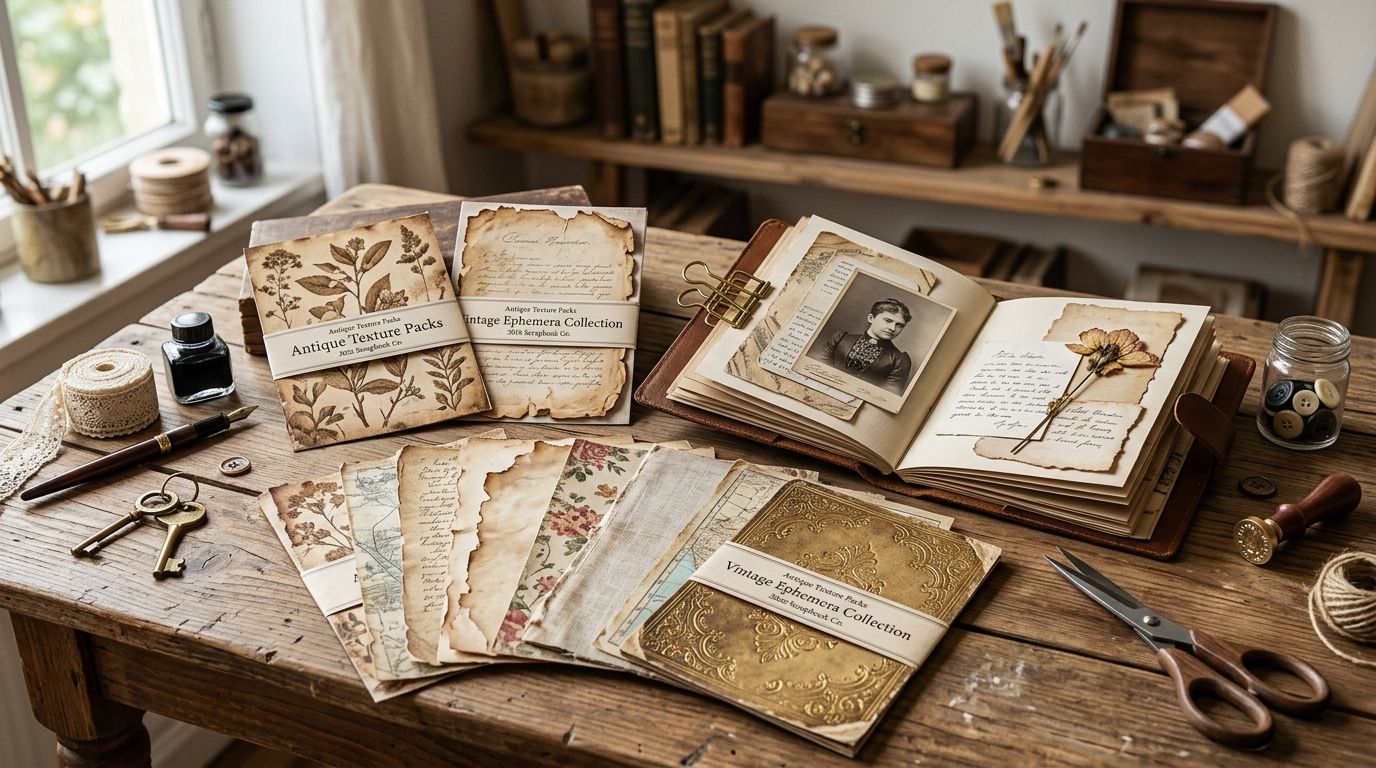
This category covers restored vintage paper textures — aged stock, foxed sheets, deckled-edge stationery — pulled from real period paper rather than a Photoshop overlay trick. For scrapbooking, these work as the base layer under photos, journaling blocks, and embellishments.
Vintage Paper & Parchment Textures pros:
- Reads as genuine aged paper up close, including under flatbed scanning for digital kits
- Wide tonal range from cream to deep foxed brown
- Works equally well as a full background or a subtle overlay at reduced opacity
Vintage Paper & Parchment Textures cons:
- Fewer pattern-style options compared to toile or textile-based textures
- Some plates carry heavier foxing than a clean, minimalist layout wants
Vintage Paper & Parchment Textures access: included in Century Library's subscription archive alongside the rest of the catalogue.
Best for: designers and scrapbookers who need a believable aged-paper base for every page in a kit.
Verdict: Buy.
2. Distressed Grunge Textures: best antique texture pack for mixed-media journal pages
The distressed grunge textures collection leans harder into wear — scuffed print runs, ink bleed, uneven ink saturation from old letterpress and offset runs. Travel journals, junk journals, and layered mixed-media spreads use these to break up clean digital edges.
Distressed Grunge Textures pros:
- Genuine print-run artifacts, not a generic "grunge brush" pack
- Layers well over photos without fully obscuring them
- Good range from light wear to heavy distress in one collection
Distressed Grunge Textures cons:
- Heavier files can crowd a page if stacked with busy patterns
- Not the right choice for clean, minimalist wedding-style layouts
Distressed Grunge Textures access: part of the same Century Library subscription, no separate purchase.
Best for: travel journals and mixed-media spreads that want visible wear, not polish.
Verdict: Buy.
3. Vintage Toile & Pattern Textures: best antique texture pack for repeating background sheets
Vintage toile patterns restored from 18th and 19th-century textile prints give you seamless, repeating motifs — florals, pastoral scenes, engraved-style linework. Scrapbookers use these as full-page patterned backgrounds or as a border strip along a page edge.
Vintage Toile & Pattern Textures pros:
- True repeat patterns, useful for full 12x12 background sheets
- Engraved detail holds up at high print resolution
- Pairs well with plainer embellishments since the pattern carries the visual interest
Vintage Toile & Pattern Textures cons:
- Busier than a plain parchment background, wrong choice for photo-heavy pages
- Needs a simpler layout around it or the page reads cluttered
Best for: repeat-pattern background sheets on pages with fewer photos.
Verdict: Buy for pattern-forward layouts, Skip for photo-dense pages.
4. Historical Clip Art & Ephemera Collections: best antique texture pack for embellishments and cutouts
This isn't a background texture at all — it's individually cataloged historical clip art: postage stamps, ledger scraps, ticket stubs, handwritten fragments. Scrapbookers layer these as cut-and-paste embellishments over the texture backgrounds above.
Historical Clip Art & Ephemera Collections pros:
- Individually cataloged plates, easy to pull single pieces instead of a whole sheet
- Real ephemera sourcing gives embellishments a genuine, not clip-art-generic, look
- Pairs directly with any of the background texture categories above
Historical Clip Art & Ephemera Collections cons:
- Not usable as a standalone page background
- Some plates need manual cropping since they weren't restored as isolated cutouts
Best for: the small embellishment layer, not the base page.
Verdict: Buy as a companion to a background texture.
5. Vintage Clip Art & Licensing Collection: best antique texture pack for commercially sold kits
For scrapbookers who resell finished kits or printables, licensing terms matter more than texture variety. This category focuses on illustration and ephemera cleared for commercial resale, which matters if the finished product leaves your own scrapbook.
Vintage Clip Art & Licensing Collection pros:
- Terms built around resale in finished products, not just personal-use display
- Draws from the same restored archive as the texture categories above
Vintage Clip Art & Licensing Collection cons:
- Skews more illustration-forward than pure texture, so it's not a background substitute
- Best paired with a texture category rather than used alone
Best for: sellers building kits or printables for commercial distribution.
Verdict: Buy if you resell finished work, Hold if scrapbooking stays personal.
“A texture pack with zero AI-generated files is the one that survives a close-up scan, not just a thumbnail preview.”
How this ranking works
Each category was weighed against the six criteria above — authentic sourcing, restoration quality, tonal range, print-ready resolution, license clarity, and file flexibility. Vintage Paper & Parchment Textures ranks first because it hits every criterion for the single most common scrapbooking use case: a full-page background that has to hold up under a photo, journaling, and embellishments layered on top.
Which antique texture pack should you choose?
For most scrapbookers building full pages in 2026, Vintage Paper & Parchment Textures is the default pick — it's the base layer everything else sits on. Add Distressed Grunge Textures for mixed-media spreads, Vintage Toile & Pattern Textures when a page needs a full patterned sheet instead of plain background, and Historical Clip Art & Ephemera Collections for the embellishment layer on top. If any of it gets resold as a finished kit, check the licensing terms on the Vintage Clip Art & Licensing Collection before publishing.
Browse the full Century Library archive
50,000+ restored illustrations, fonts, patterns, and textures in one subscription.
FAQ
What's the best antique texture pack for scrapbooking in 2026?
Vintage Paper & Parchment Textures is the best overall pick for scrapbooking backgrounds in 2026 because it works as a base layer under photos and embellishments. Distressed Grunge Textures and Vintage Toile & Pattern Textures cover more specific page styles.
Are antique texture packs from Century Library AI-generated?
No. Century Library sources every texture and illustration from restored 19th and early 20th-century printed material, not AI generation. Restoration removes scan noise and print artifacts while keeping genuine wear.
Can I sell scrapbook kits made with these textures commercially?
That depends on the license terms attached to each category, which is why the Vintage Clip Art & Licensing Collection exists as a separate category. Check the resale terms before publishing a kit built for commercial distribution.
What resolution do antique texture packs need for print scrapbooking?
Print scrapbooking generally needs textures at 300 dpi or higher, the standard resolution for physical print output. Screen-only digital scrapbooking can work with lower resolution files.
Is distressed grunge texture the same as vintage paper texture?
No. Vintage paper and parchment textures show aged paper grain and foxing, while distressed grunge textures emphasize scuffed print marks, ink bleed, and uneven toning from old print runs. They layer well together but solve different problems.
What's the difference between a texture pack and a clip art collection?
A texture pack is a full-surface background or overlay file, while clip art is individually cataloged imagery meant to be cut out and placed as an embellishment. Historical Clip Art & Ephemera Collections is the clip art category in this ranking, not a texture.
Do toile patterns work for scrapbook backgrounds?
Yes, Vintage Toile & Pattern Textures work well as full-page repeating background sheets, especially on pages with fewer photos. They read as busier than plain parchment, so pair them with simpler embellishments.
One last thing
Foxing — the brown spotting that shows up on aged paper — isn't a flaw to filter out in restoration; it's the detail that makes a texture read as genuinely old rather than tinted. If a texture pack has zero visible foxing, print artifacts, or paper grain variation across its whole set, that's usually the tell that it started as a photo filter, not a scanned plate.