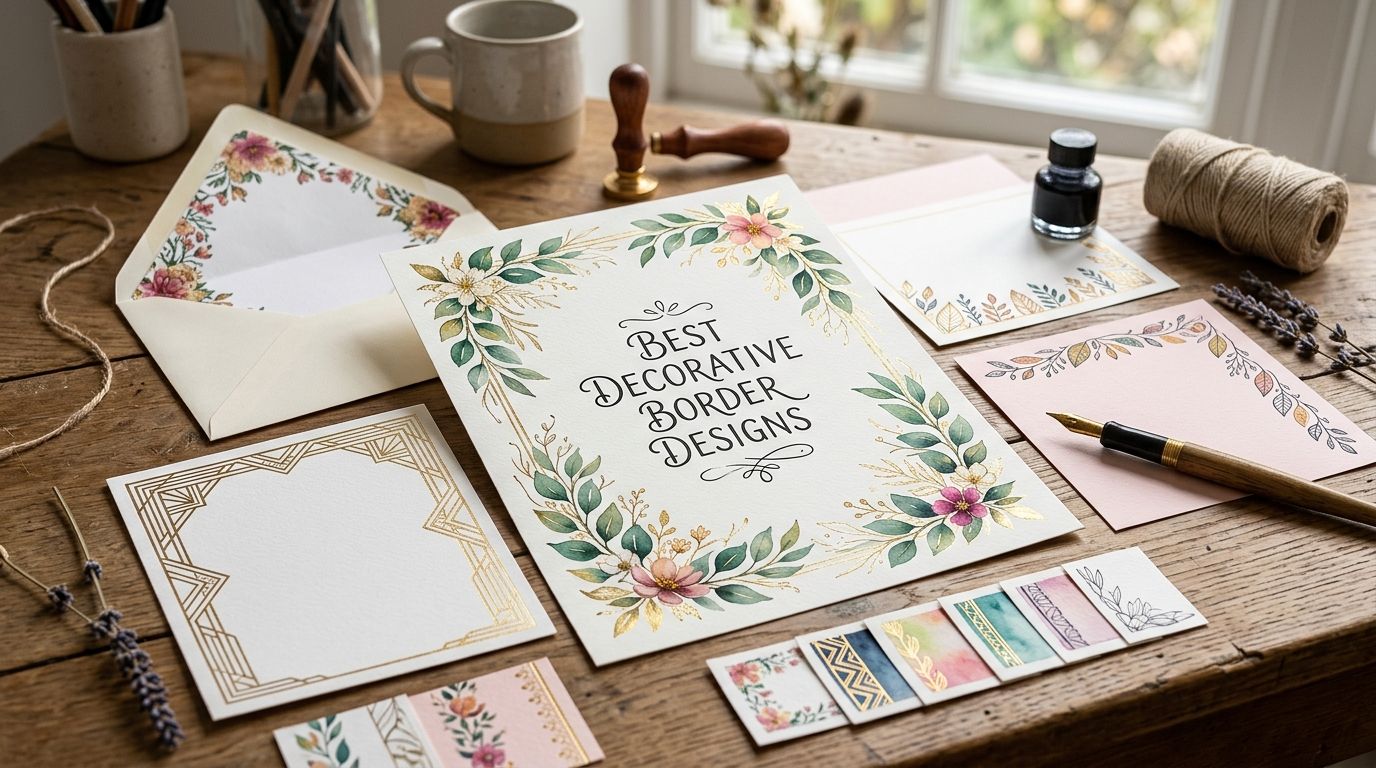
Choosing decorative borders for stationery in 2026 means picking motifs that survive scaling to invitation card size, print cleanly in single-color runs, and don't fight the typography sitting inside them. This guide ranks seven hand-restored border sets from Century Library's archive by the stationery job each one solves best, not by which looks fanciest in a thumbnail.
- Best overall decorative borders for stationery in 2026: the Five-Panel Scrollwork set, built for greeting cards and note cards.
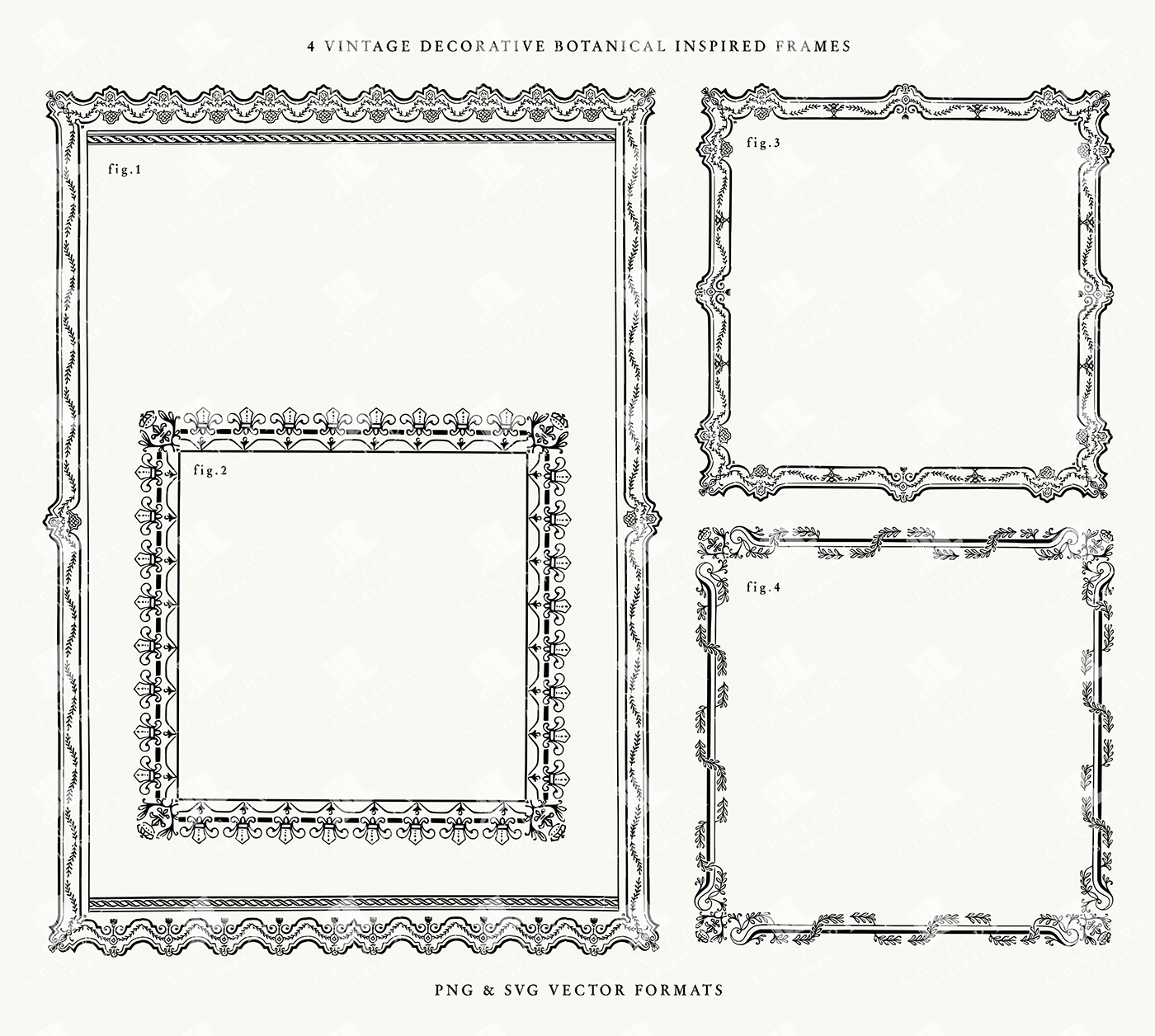
- Best for wedding invitations: the Ornate Botanical Line-art Frames, with scalloped edges and floral corner accents.
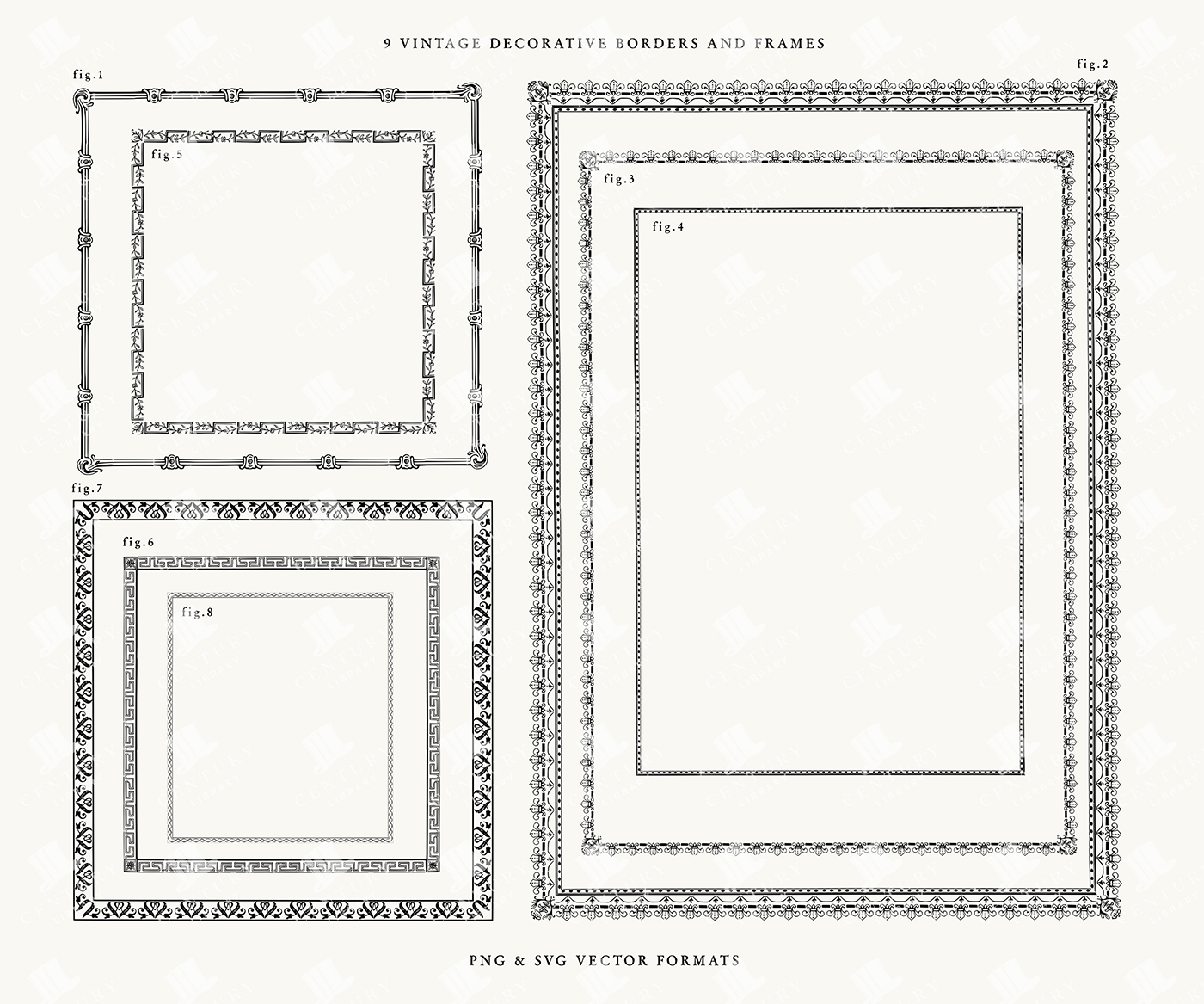
- Best for certificates and formal letterhead: the Rosette, Clover and Acanthus set with Greek key detailing.
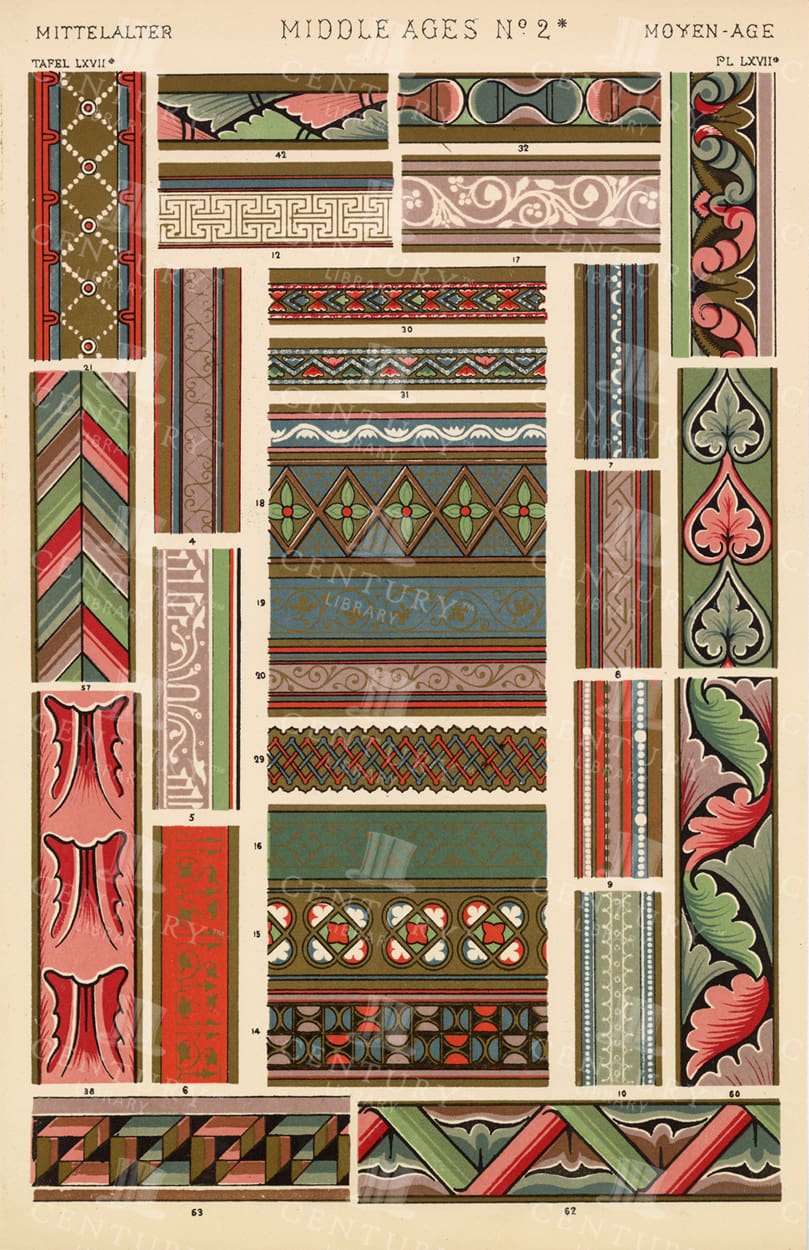
- Best for packaging and labels: the Owen Jones Medieval polychrome plate, restored from an 1865 print.
- All seven sets are hand-restored vector and PNG files, not AI-generated art.
Why this matters
A border does more work on a wedding suite or a product label than most designers give it credit for. It sets the formality level before a single word is read, and a mismatched line weight between border and typeface reads as amateur even when the copy is polished.
Most stock libraries solve this with generic corner flourishes that show up on a hundred other brands the same month. Century Library's decorative borders come from restored 19th-century plates and printer's specimens, so the linework has the irregularity and depth that flat vector clip art doesn't. That's the difference between a border that looks licensed and one that looks like it belongs on the page. Browse the full Century Library archive for the source plates behind every set below.
What makes the best decorative border for stationery
- Line weight consistency — thin, even strokes that hold up at business-card scale without clogging into a solid mass
- Restoration quality — cleaned from the original plate or specimen page, not traced or auto-vectorized from a low-res scan
- Format flexibility — available as SVG for resizing and PNG for quick placement in layout software
- Motif variety within one set — multiple frame or panel options so a single purchase covers more than one layout
- Historical authenticity — sourced from a dated plate or foundry catalog, never AI-generated
- Commercial usability — clean enough linework to print in one color on letterpress or foil stock
Decorative borders for stationery: at a glance
| Border set | Best for | Standout feature | Key limitation |
|---|---|---|---|
| Five-Panel Scrollwork Borders | Greeting cards & note cards | Five distinct frame styles in one file | Scrollwork density needs generous margins |
| Ornate Botanical Line-art Frames | Wedding invitations | Scalloped edges with floral corner accents | Only four frame variants included |
| Rosette, Clover & Acanthus Borders | Certificates & formal letterhead | Greek key and beaded line detailing | Formality can feel stiff for casual cards |
| Six Rectangular Borders (Two Rows) | Business stationery & letterhead | Laurel corners, rounded and notched options | Less ornate than the other sets by design |
| Medieval Borders (Owen Jones plate) | Packaging & label design | Polychrome interlace and acanthus scrollwork | Color plate needs recoloring for single-tone print |
| Renaissance Borders (Owen Jones plate) | Scrapbooking & mixed-media crafts | Over thirty border variations on one plate | Requires cropping individual motifs out |
| Rococo Borders with Dancing Figures | Romantic & anniversary stationery | Figural vignettes in 18th-century dress | Figures narrow it to a specific aesthetic |
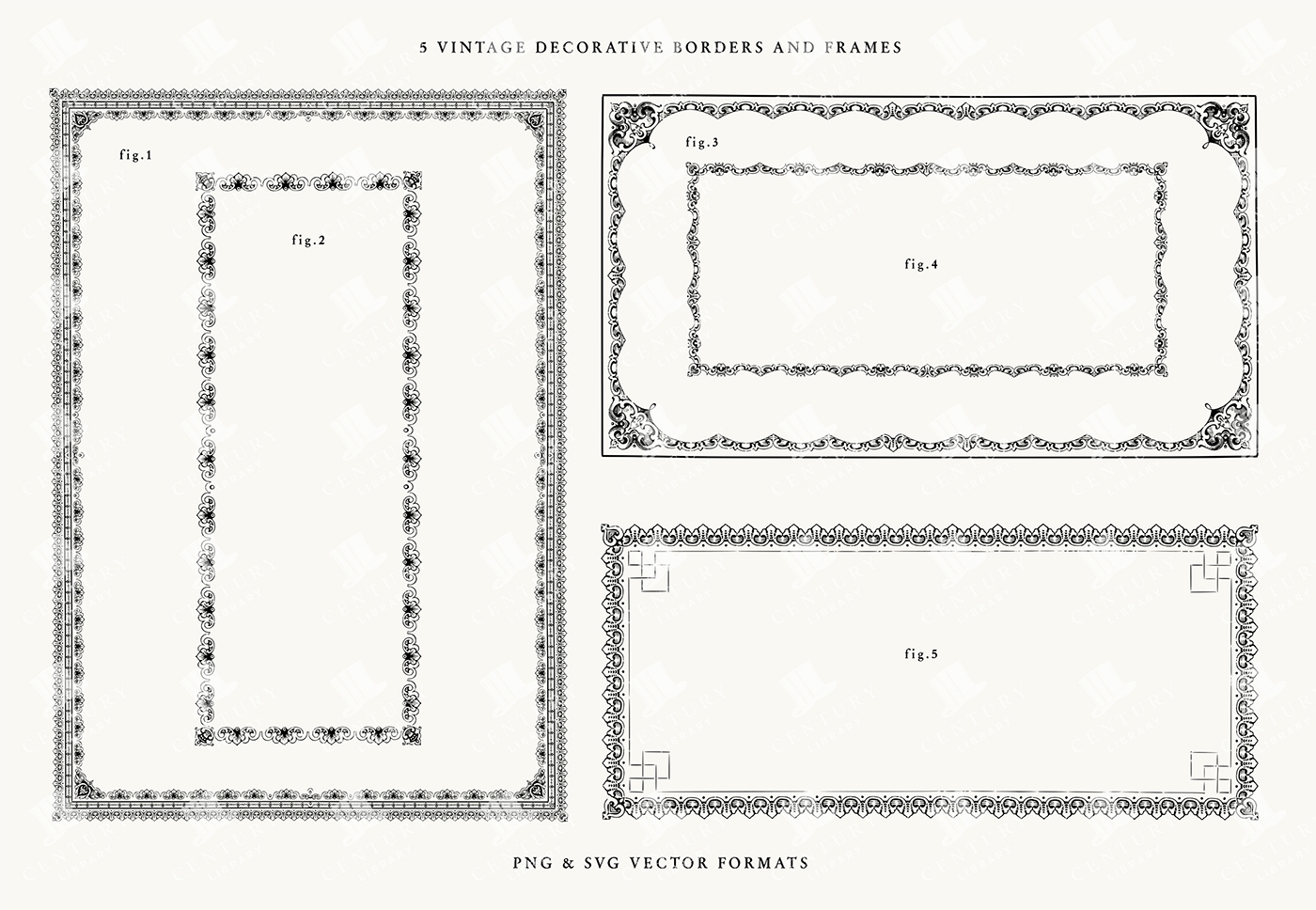
1. Five-Panel Scrollwork Borders: best decorative border for greeting cards and note cards
This set packs five separate border frames into one file, moving from tight scalloped edges to loose floral scrollwork. That range means one purchase covers a birthday card layout and a formal note card without buying two sets.
Five-Panel Scrollwork Borders pros:
- Five distinct styles cut down on repeat-purchase need
- Fine linework holds up at 4x6 card scale
- Works as a full border or trimmed down to a corner accent
Five-Panel Scrollwork Borders cons:
- Denser scrollwork variants need wider margins around the text block
- No color variants included
Best for: designers producing a run of greeting cards who need more than one border option in a single file. Verdict: Buy.
2. Ornate Botanical Line-art Frames: best decorative border for wedding invitations
Four frames with scalloped edges and floral corner flourishes, arranged as one tall rectangle plus three smaller layouts. The botanical detailing reads as garden-party formal without tipping into anything a bride would call dated.
Ornate Botanical Line-art Frames pros:
- Scalloped edge softens formal invitation copy
- Corner-only flourish option for minimalist suites
- Restored linework prints cleanly on cotton or pearl stock
Ornate Botanical Line-art Frames cons:
- Only four frame variants, fewer options than the scrollwork set
- Botanical style narrows it away from modern-minimalist weddings
Best for: save-the-dates and formal invitation suites. Pair it with a script typeface from Century Library's calligraphy fonts for wedding invitations roundup for the full set. Verdict: Buy.
3. Rosette, Clover and Acanthus Borders: best decorative border for certificates and formal letterhead
Grouped rectangular and square frames combining rosette medallions, clover motifs, Greek key trim, and beaded lines. This is the most classically formal set in the lineup, which is exactly the point for anything meant to read as an official document.
Rosette, Clover and Acanthus Borders pros:
- Greek key and beaded detailing signal credential-grade formality
- Square and rectangular layouts fit both certificate and letterhead proportions
- Fine linework prints well in single-color foil
Rosette, Clover and Acanthus Borders cons:
- Too stiff for casual greeting card or scrapbook use
- Multiple motifs in one sheet require some cropping to isolate a single design
Best for: award certificates, diplomas, and formal business letterhead. Verdict: Buy.
4. Six Rectangular Borders (Two Rows): best decorative border for business stationery
Six rectangular frames arranged in two rows, combining plain stepped treatments, laurel corners, and rounded or notched edges. It's the most restrained set here, built for brand stationery that needs a finished edge without decoration competing for attention.
Six Rectangular Borders pros:
- Laurel corner option adds credibility without heavy ornamentation
- Fine hatching gives texture without cluttering a business card layout
- Six variants cover letterhead, envelope, and card stock in one file
Six Rectangular Borders cons:
- Less decorative than the other six sets, which won't suit every brief
- Hatching detail can get lost at very small print sizes
Best for: brand identity stationery where the border needs to stay in the background. Verdict: Buy.
5. Medieval Borders (Owen Jones Plate): best decorative border for packaging and label design
Restored from an 1865 Owen Jones print, this polychrome plate carries interlace patterns, acanthus scrolls, geometric bands, and trefoil motifs in earthy reds and greens. The color and pattern density read well on packaging where a border needs to hold its own against product photography or a busy shelf.
Medieval Borders pros:
- Full-color plate gives packaging designers a ready palette reference
- Geometric banding works as a repeatable strip pattern
- Sourced from a documented 1865 print, not a modern reproduction
Medieval Borders cons:
- The polychrome original needs recoloring work for single-tone print jobs
- Dense pattern isn't suited to small labels under two inches
Best for: packaging bands, wine labels, and product tags needing historical texture. Verdict: Buy.
6. Renaissance Borders (Owen Jones Plate): best decorative border for scrapbooking and mixed-media crafts
This chromolithograph plate holds over thirty individual Renaissance border designs on one page, from scalloped fish-scale bands to stylized floral friezes. That volume makes it a cutting library rather than a single asset, which is exactly what scrapbookers and mixed-media crafters want.
Renaissance Borders pros:
- Thirty-plus motifs on one plate means dozens of project uses from a single file
- Fish-scale and interlocking patterns work as both borders and standalone accents
- Restored chromolithograph detail holds up when printed at full size
Renaissance Borders cons:
- Individual motifs need to be cropped out of the full plate manually
- Not pre-separated into single-use files
Best for: crafters building a personal library of border cuttings for repeated project use. Verdict: Buy.
7. Rococo Borders with Dancing Figures: best decorative border for romantic and anniversary stationery
Corner pieces, frames, and figural vignettes of 18th-century couples dancing and courting, wrapped in ornate scrollwork. It's the most narrative set in the lineup — the figures do real storytelling work that a plain floral border can't.
Rococo Borders pros:
- Figural vignettes add narrative warmth to romantic-themed stationery
- Scrollwork corner pieces work independently of the figures if a simpler layout is needed
- Restored from period source material, distinct from generic clip-art cupids
Rococo Borders cons:
- The dancing-figure motif narrows it to a specific romantic aesthetic
- Not a fit for corporate or minimalist stationery briefs
Best for: anniversary cards, romantic-themed wedding stationery, and vintage-styled invitations. Verdict: Buy.
How we ranked
Each set was scored against the six criteria above: line weight consistency, restoration quality, format flexibility, motif variety, historical sourcing, and print usability at stationery scale. Sets that only excelled in one category — decorative but poorly restored, or authentic but too dense to reproduce — dropped in rank even when the source material was impressive.
Which decorative border should you choose?
For most stationery work in 2026, start with the Five-Panel Scrollwork Borders — five styles in one file covers greeting cards, note cards, and general branding without a second purchase. Wedding designers should go straight to the Ornate Botanical Line-art Frames, and anyone producing certificates or formal letterhead needs the Rosette, Clover and Acanthus set. If the project is packaging rather than paper goods, the Owen Jones Medieval plate carries more color depth than anything else on this list.
Every set here comes from a restored plate or printer's specimen, never AI-generated linework, which matters if a client asks where the artwork came from. Pair a border with typography from Century Library's Victorian display fonts for stationery design collection to keep the formality level matched top to bottom.
“A border sets the formality level of a page before a single word gets read.”
FAQ
What are the best decorative borders for stationery in 2026?
The Five-Panel Scrollwork Borders rank best overall for stationery in 2026, with the Ornate Botanical Line-art Frames as the top pick specifically for wedding invitations. Both are restored vector and PNG sets rather than AI-generated art.
Are vintage decorative borders better than modern clip art for stationery?
Restored vintage borders carry irregular linework and period detail that flat modern clip art doesn't replicate. That texture reads as more credible on formal stationery like invitations and certificates.
Can decorative borders be used for commercial branding projects?
Yes, Century Library's decorative borders are sold for commercial use in branding, packaging, and stationery projects. Check the license terms on each product page before use.
What file formats do decorative border designs come in?
Most Century Library border sets ship as SVG and PNG files, so they scale for both print and digital layout work. SVG keeps linework clean at large sizes like posters or packaging bands.
Which decorative border works best for wedding invitations?
The Ornate Botanical Line-art Frames set is built for wedding invitations, with scalloped edges and floral corner accents across four frame variants. It pairs well with a script or calligraphy typeface.
Do decorative borders work for packaging design, not just paper stationery?
Yes, the Owen Jones Medieval polychrome plate is suited to packaging and label design because of its color depth and repeatable geometric banding. Single-tone print jobs will need to recolor the plate first.
How many border styles come in one Century Library set?
It varies by set: the Five-Panel Scrollwork Borders include five styles, while the Renaissance Owen Jones plate holds over thirty individual border designs on one page.
Is AI-generated border art as good as restored vintage borders?
AI-generated borders lack a documented historical source and often show repeating artifacts under close inspection. Century Library's sets are restored from dated plates and printer's specimens, not generated.
One last thing
The Renaissance Owen Jones plate isn't really one asset — it's a reference sheet of over thirty separate border designs from a single 1865 chromolithograph, which makes it closer to a personal cutting library than a single download. Crop three or four motifs out of it and you've effectively built three or four custom border sets for the price of one plate.